Back to Blog
What Is the Best Wood for Beginner Carving?
Compare basswood, butternut, aspen, and pine and learn which wood makes learning to carve easier.
If you are new to wood carving, choosing the right piece of wood can make a surprisingly big difference.
A beginner working with hard, knotty, or unpredictable wood may struggle to make clean cuts and assume their technique is the problem. Start with a softer, straight-grained wood, however, and learning knife control, grain direction, and basic shaping becomes much easier.
So, what is the best wood for beginner carving?
For most beginners, basswood is the best wood to start carving. It is relatively soft, has a fine and even grain, holds detail well, and is widely used for hand carving. But it isn't your only option.
Let's look at why basswood works so well and a few other beginner-friendly woods worth trying.
The Best Wood for Beginners: Basswood
If you only want one recommendation, start with basswood.
Basswood (Tilia americana) has been a traditional carving wood for good reason. Woodcraft describes it as having a straight grain and even texture while still being soft and easy to work. Despite that softness, it can hold surprisingly fine carved details.
That combination is exactly what a beginner needs.
With basswood, you can practice:
- Basic knife cuts
- Cutting with and across the grain
- Carving faces and figures
- Making V-tool cuts
- Creating small details
- Practicing stop cuts
- Painting and finishing completed carvings
Basswood also has a light, fairly neutral color, which makes pencil marks and stencil lines easy to see while you work.
Woodcraft specifically recommends basswood as a starting material for chip carving because of its low resistance to cutting.
How soft is basswood?
The Janka hardness scale measures how resistant a wood is to denting and wear. It isn't specifically a carving test, but it gives us a useful way of comparing the relative hardness of different species.
Basswood has a Janka hardness of around 410 pounds-force, compared with approximately 1,350 pounds-force for white oak.
That difference becomes very noticeable when you're pushing a carving knife through the wood by hand.
A softer wood requires less force, which can make it easier for a beginner to concentrate on control rather than strength.
What Makes a Wood Good for Beginner Carving?
Softness is important, but simply choosing the softest wood you can find isn't necessarily the answer.
A good beginner carving wood should ideally have several characteristics.
Straight and predictable grain
Wood grain determines how your knife travels through the material.
Straight grain is generally easier to understand and control. Grain that twists around knots or changes direction suddenly can cause a knife to dive deeper than expected or tear out part of your carving.
Even with soft wood, look for pieces that are straight-grained and relatively free from knots. Woodcraft recommends straight-grained material because knots and irregular grain can make carving difficult even in otherwise easy-to-carve species.
Fine, even texture
Fine-grained woods tend to hold small details better.
This becomes especially useful when carving:
- Eyes
- Noses
- Beards
- Facial expressions
- Clothing folds
- Decorative patterns
Basswood performs particularly well here because its texture is relatively uniform.
Enough softness to carve comfortably
Beginners are still developing their knife control.
If the wood requires excessive pressure to cut, there is a greater temptation to force the blade. A properly sharpened carving knife should be able to slice through beginner-friendly carving wood without excessive effort.
Keep in mind, though, that even soft wood becomes frustrating with a dull knife.
Sharp tools are just as important as choosing the right wood.
Other Good Woods for Beginner Carvers
Basswood may be our first recommendation, but there are several other woods worth experimenting with.
1. Butternut
Best for: Beginners who want visible natural wood grain.
Butternut is an excellent step sideways from basswood.
It is still relatively soft and easy to work with hand tools, but it has much more noticeable grain and color. The Wood Database lists butternut at about 490 pounds-force on the Janka scale and describes it as easy to work with hand tools.
That makes it slightly harder than basswood but still very approachable.
Butternut is especially attractive if you plan to leave your carving with a natural or oil finish instead of painting it.
The downside is that its more pronounced grain can occasionally work against very small details. Beginners also need to pay more attention to grain direction.
Beginner rating: Excellent
2. Aspen
Best for: Inexpensive practice and simple carving projects.
Aspen is another soft hardwood.
Quaking aspen measures around 350 pounds-force on the Janka scale, making it technically even softer than basswood by that measurement. It generally has straight grain and is considered easy to work with hand tools.
However, softness isn't everything.
Aspen can sometimes develop fuzzy surfaces when it is cut with less-than-sharp tools, so maintaining a sharp carving knife becomes important.
For practice blocks and larger, simpler shapes, it can still be a good choice.
Beginner rating: Very good
3. Eastern White Pine
Best for: Cheap practice wood when clean pieces are available.
Pine is readily available at many hardware stores, which makes it tempting for beginner carvers.
Certain varieties can work surprisingly well.
Eastern white pine, for example, has a Janka hardness of approximately 380 pounds-force and generally has a straight grain. Woodcraft also lists clear white pine among suitable starter woods for chip carving.
The key word here is clear.
Construction-grade pine frequently contains knots and major grain changes. Those areas can be considerably more difficult to carve than the surrounding wood.
If you're buying pine for carving, look for a straight, clean section without knots.
Beginner rating: Good, if you choose the right piece
Basswood vs. Butternut vs. Aspen vs. Pine
Here's a simple comparison:
Wood | Ease of Carving | Grain | Detail | Good for Beginners? |
|---|---|---|---|---|
Basswood | Very Easy | Fine and subtle | Excellent | Best overall |
Butternut | Easy | More visible | Very Good | Excellent |
Aspen | Easy | Mild | Good | Very Good |
White Pine | Easy to Moderate | More noticeable | Good | Good when knot-free |
For your first wood carving project, we'd choose basswood.
Once you're comfortable controlling your knife and understanding grain direction, experiment with the others.
Woods Beginners May Want to Save for Later
Technically, almost any wood can be carved.
That doesn't mean every wood makes sense for your first project.
Dense woods such as oak, hard maple, and some walnut species generally require more force and better-developed tool control. Coarse grain can create additional challenges as well. Woodcraft notes that woods such as oak and ash can be harder to carve because of their coarser grain, while dense species such as maple can also be more difficult to cut.
There is nothing wrong with eventually carving harder woods.
In fact, experimenting with different species is part of becoming a better carver.
But your first project is probably not the time to make things unnecessarily difficult.
Don't Blame Yourself Before Checking the Wood
This is an important lesson for new carvers.
If your knife constantly feels stuck, the wood keeps tearing, and every cut requires a lot of pressure, your technique may not be the only problem.
Check three things:
- Is your knife sharp?
- Are you cutting in the correct direction for the grain?
- Are you using suitable carving wood?
A beginner using sharp tools on clean basswood will usually have a much easier time learning than someone trying to carve through a knot-filled construction lumber scrap.
Removing those unnecessary difficulties lets you focus on learning the actual carving techniques.
Start With a Small Basswood Project
You don't need a huge block of wood for your first carving.
Start small.
A simple face, gnome, Santa, animal, practice block, or other small figure gives you an opportunity to learn how the grain behaves without committing to a large project.
Having a clear layout also helps. Rather than trying to design everything freehand while simultaneously learning how to carve, you can trace a pattern or use a wood carving stencil to establish your major
As an Amazon Associate I earn from qualifying purchases.
Featured Products
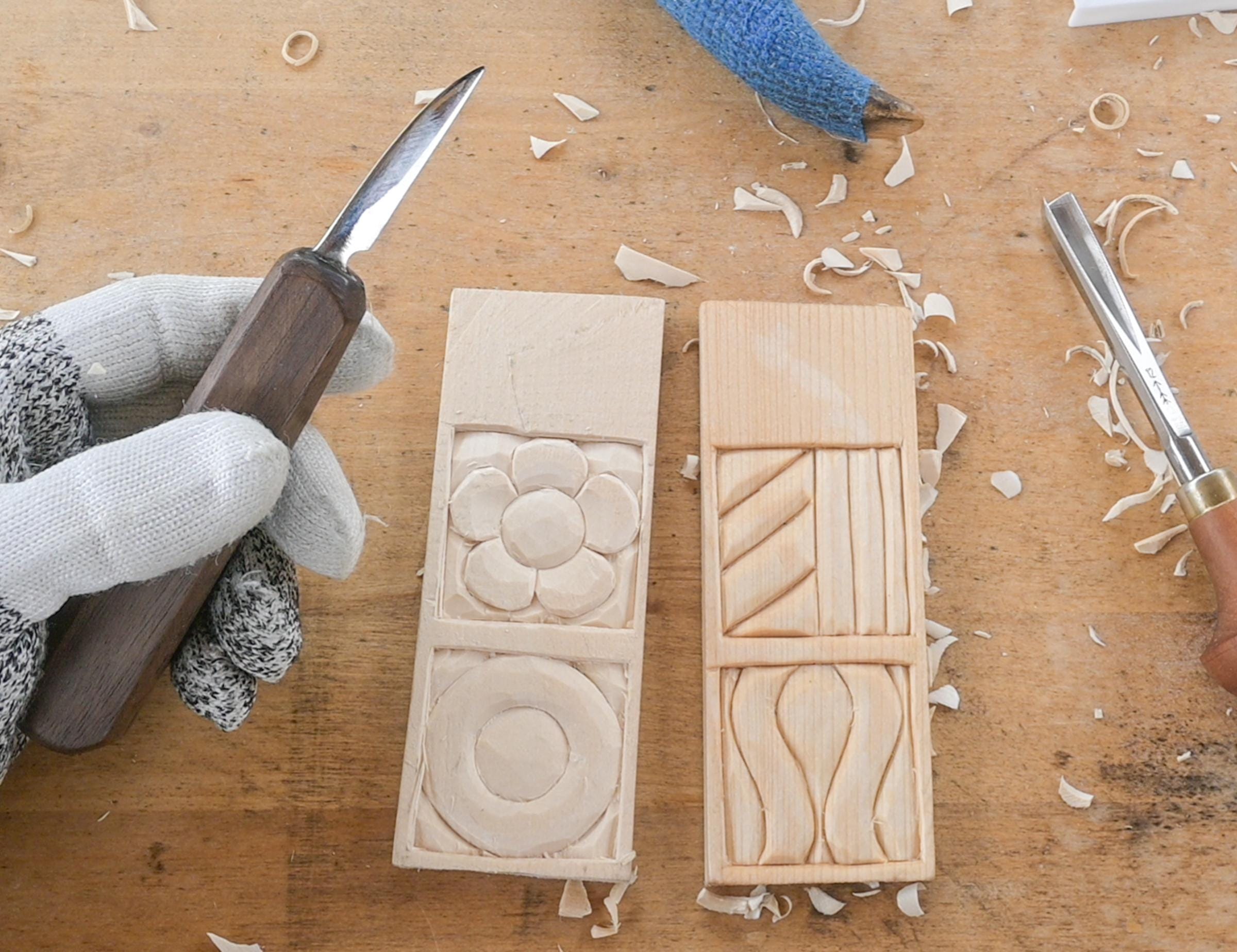
Practice Wood Carving Stencil SET
Used in video$9.99
Watch related stencil tutorials
Pair this guide with Ronan3D video tutorials for step-by-step carving demonstrations and product walkthroughs.
Browse Tutorials